Wall-Mounted vs. Floor-Standing Closets: Which Is Right for You?
Three questions settle most closet decisions before you look at a single catalog page.
Does the floor slope, dip or change height near the door?
Is the room small enough that every visible inch of floor helps?
Do you actually know what's behind the drywall?
If you answered yes to the first two, a wall-mounted closet is probably your match. If the third answer is a shrug, or you're storing a lot of heavy things, a floor-standing closet is the safer pick. The rest of this article explains why, gives you a quick way to test your own room, and shows what's inside our wall-mounted closets and floor-standing closets.
Living with a wall-mounted closet
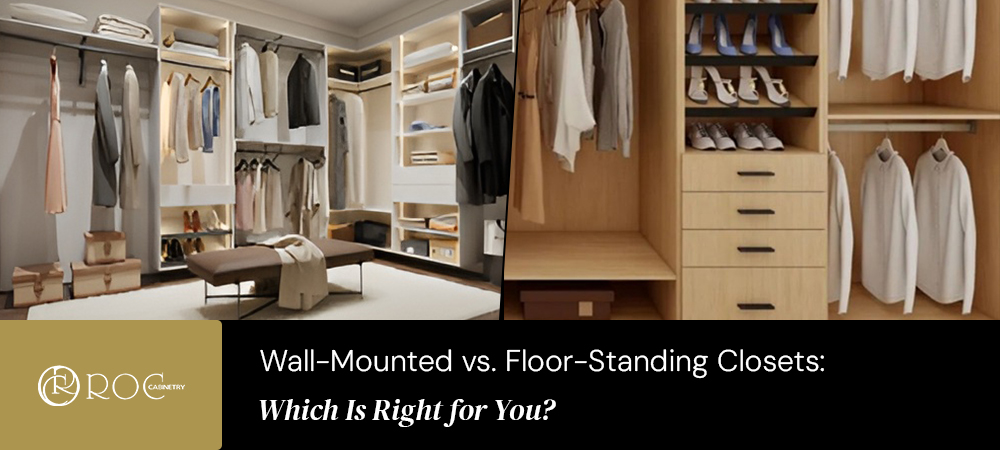
Picture sweeping a bedroom without ever stopping to work around a cabinet base. With a floating closet the floor runs straight under the units, so a vacuum slides through, a mop follows, and there's no ledge for lint to gather on. That open strip does something for the eye too. In a small bedroom or a condo reach-in, seeing the floor continue makes the closet feel lighter and the whole room a little larger.
Hanging also dodges a lot of floor trouble. If the boards have dipped over the years or the tile by the door sits a bit proud, you're lining things up against the wall instead of chasing a level line with shims. What a floating closet asks in return is a sound wall. Find the studs, know what you're fastening into, and keep the heavy items on the lower shelves and drawers.
Living with a floor-standing closet
A standing unit behaves like a good dresser: the floor takes the weight and the wall mostly keeps it upright. That makes it the calmer choice for a closet you plan to fill to the brim with boots, folded jeans, storage bins and a serious coat collection. It's also the answer when you don't entirely trust the wall, whether that means old plaster, thin drywall or a stretch with no framing where you need it. In a big walk-in, the solid base gives the room a built-in, furniture-like feel.
You pay for that in two small ways. The floor has to be level enough, or you'll be shimming, and the base is one more spot where dust settles. Neither of our closet pages lists a weight limit, so if you're planning something unusually heavy, ask us before you order.
A five-minute test for your own room
Set a level where the closet will go and watch the bubble. If it drifts well off center, that's a vote for hanging.
Run a stud finder along the wall. A clear line of framing across the whole span is another vote for hanging, and gaps are a vote for standing.
Pile up what you plan to store, roughly. If the heavy pile is bigger than the light one, lean toward standing.
Side by side
What goes into our closets
Both systems start with ¾-inch P2 furniture-grade melamine particle board and ⅜-inch backs, and both go together with cam-lock connectors, so assembly stays simple. Our closet assembly instructions show the steps. Drawers run on full-extension, soft-close, under-mount slides, and the hanging rod and the front trim on the shoe shelf are aluminum. Both lines also meet the TSCA Title VI formaldehyde standard.
The wall-mounted line is 78-5/8 inches tall with side panels 15-5/8 inches deep. Its edges are PVC applied with PUR technology, and the spec includes a 96-inch plywood cleat. Finishes are Matte White, Beech Wood, Honey Oak, Walnut, Espresso Oak and Rustic Oak.
The floor-standing line matches that 15-5/8-inch depth, uses ABS edge banding and rests on a 3-inch toe kick. It comes in Soft White, Ashton Oak and Slate Oak. For sizes and layouts, see the wall-mounted specbook and the floor-standing specbook.
Questions people ask
1.Can both styles live in the same house?
Sure. Plenty of homes end up with hanging units in a guest room and standing units in the primary suite, simply because the rooms are different.
2.Is a floating closet harder to install?
Assembly is the same cam-lock process for both. The part that takes care is fastening a wall-mounted unit to the studs, which many people hand to an installer.
3. Which one suits a very small closet?
Usually the wall-mounted one, as long as the wall behind it is solid.
Making the call
Let the room decide, not the catalog photo. A level, a stud finder and an honest look at your pile of boots will tell you more than any showroom can. Once you know which way you're leaning, the finishes are the fun part: browse the wall-mounted and floor-standing ranges and see what suits your space. Contractors and dealers can reach our team any time, or open a dealer account to order at wholesale.