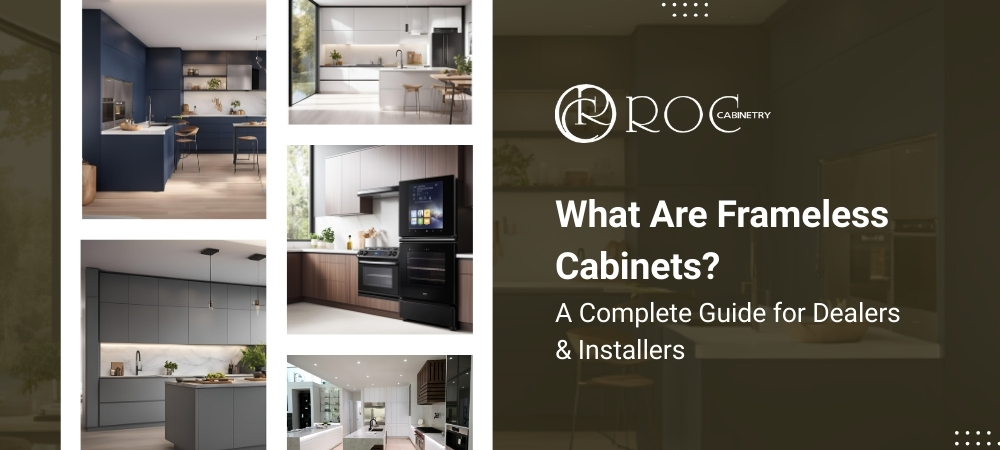
What Are Frameless Cabinets? A Complete Guide for Dealers & Cabinet Installers
The choice between framed and frameless cabinetry is about balancing project labor, structural requirements, and client budgets. For contractors and dealers, understanding the technical trade-offs of each is essential for a successful bid.
Understanding the Cabinet Construction
Framed cabinets feature a 1.5-inch solid wood face frame attached to the front of the cabinet box. The frame acts as a structural backbone and provides a lip around the cabinet's openings. According to Builder Online, 55-60% of U.S. cabinet installations in 2026 will be framed cabinets.
Frameless cabinets eliminate the face frame. The cabinet relies on thicker side panels for integrity, with doors mounted directly to the box for a seamless look. As Global Newswire reports, about 40-45% of U.S. cabinet installations in 2026 will be frameless.
Key Considerations for Dealers & Cabinet Installers
Understanding practical and logistical factors is key. Here’s what dealers and cabinet installers should weigh:
- Material&Manufacturing Requirements
Frameless cabinets need thicker side panels and precision hardware. Any minor defect in the panel can compromise the box's integrity. On the other hand, framed cabinets with standard thickness panels work. Face frames add rigidity, reducing reliance on exact manufacturing tolerances.
- Labor and Cabinet Installation
Installing frameless cabinets requires skilled cabinet installers. Precision leveling and squaring are critical. Even small wall irregularities can cause misaligned doors. Framed cabinets are more forgiving for uneven walls. The frame can hide minor errors, which can save time during installation and reduce callbacks.
- Storage and Functionality
Frameless cabinets provide 10–15% more interior storage and wider drawers. Ideal for kitchens with high functionality demands, while framed have slightly less usable interior space because of the frame lips while remaining functional for most residential projects.
- Customer Insights & Market Trends
Frameless cabinets coordinate with kitchens that are:
- Modern
- Minimalist
- European-inspired
Clients often perceive it as premium and may expect higher-end finishes. Conversely, framed resonates with a variety of designs. Often preferred in remodels of older homes where a traditional look is required.
- Cost Implications
Frameless can be slightly more expensive because of higher-grade materials and hardware needs. Labor cost may also be higher because installation requires greater skill. Typically, framed cabinets are more budget friendly. Materials are standard, and installation is faster and easier for most crews.
Clarify tradeoffs with clients. Build trust with them by offering a clear explanation of:
- Material needs
- Labor intensity
- Finished styles
Pro Tips for Dealers
- Sell Storage: Compare frameless vs. framed widths to justify price.
- Inspect Early: Check for plumbing/bowed walls; warn of extra labor.
- Premium Hardware: Pair frameless boxes with full-extension, soft-close glides.
Pro Tips for Cabinet Installers
- Laser Level: Use on floors to protect door adjustment range.
- Cabinet Claws: Use to eliminate 1/32" offsets in reveals.
- Clearance Strips: Stock 3/4" strips for drawer/hardware clearance.
- Re-Square: Fix "racked" boxes before mounting to ensure alignment.
Maximizing ROI: The Operational Impact of Cabinet Selection
- Inventory Management&Products
Since frameless cabinets rely on thicker panels and precise hardware, maintaining consistent stock levels of high-quality MDF or plywood is critical. Framed cabinets allow more flexibility with panel thickness and door styles.
Stock ROC Cabinetry’s complete framed and frameless lineups to meet diverse high-end project demands.
- Installation Workflow&Labor Planning
Frameless cabinets require highly skilled cabinet installers who handle precise:
- Leveling
- Squaring
- Alignment
Even small errors in measurement can lead to:
- Visible gaps
- Misaligned doors
- Increased installation time
Framed cabinets are more forgiving on uneven walls. Minor misalignments can be corrected with shims or adjustments during installation. This reduces labor costs and minimizes callbacks.
- IdentifyingUpsell Potential
Frameless cabinets can be positioned as a premium option, ideal for clients seeking modern aesthetics and maximum storage. Framed cabinets, by contrast, appeal to those prioritizing:
- Traditional looks
- Economical solutions
Educating clients on the differences in access, storage space, and design options can increase average project value and customer satisfaction. By understanding the practical differences and marketing angles for each cabinet style, dealers and installers can better:
- Guide clients
- Streamline installation
- Boost return on investment
Key Takeaways
The choice between framed and frameless impacts project efficiency, labor allocation, and your bottom line. Understanding how each style affects workflow can streamline operations and drive better results. Browse ROC Cabinetry’s framed and frameless varieties, including the Euro Deluxe Series, today!
FAQs
- Why the higher price for frameless?
Because they don't have a wood frame for support, we use thicker, high-grade materials to keep the boxes rock-solid.
- Which is tougher to install?
Frameless. Without a frame to hide gaps, the installer has to be a perfectionist to get everything level and flush.
- Can I get a Shaker look with frameless?
Absolutely! While flat doors are the "classic" frameless look, Shaker doors on a frameless box are a huge hit for transitional styles.
- What are the main perks of frameless?
Total accessibility. No frame means more room for your stuff and a sleek, seamless look.
- Are framed cabinets tougher?
Framed cabinets are a bit more "forgiving" during shipping and installation. Frameless units are just as durable, but they rely on precision engineering and thicker panels rather than a front frame.
- Does ROC Cabinetry carry both frameless and framed?
We sure do! Whether you need modern frameless or traditional framed, we have the inventory for every project and budget. For projects requiring framed cabinetry, customers can explore the Shaker, Classic, Belmont, Newtown, and Inset Series. For frameless cabinet projects, the Euro Deluxe Series is the perfect fit!
- When comparing frameless cabinets vs. framed cabinets, is the labor more expensive?
Usually, yes. It takes more time and skill to align frameless cabinets perfectly compared to the quicker "set and go" of framed options.
- Is frameless a good upsell?
Definitely. Between the extra storage and high-end finishes (like high-gloss or matte), they are an easy sell for clients wanting a premium feel.