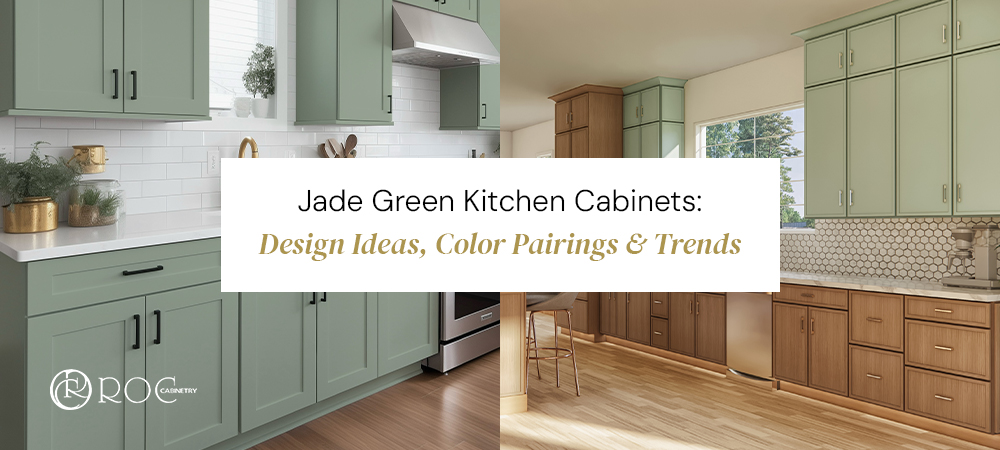
Jade Green Kitchen Cabinets: Design Ideas, Color Pairings & Trends
Five years ago, almost every colored-kitchen conversation ended at navy. Navy islands, navy lowers, navy everything. That wave has mostly passed, and what replaced it is green — specifically the muted, slightly blue-leaning greens that read more like a neutral than a color.
Jade Green sits right in that pocket. It's the shade homeowners ask about most often now, and unlike a lot of color trends, this one isn't likely to embarrass anybody in six years. Here's how to use it well.
What Jade Green actually looks like in a room
Jade Green is a mid-tone green with a cool, slightly blue undertone. It's not a sage, which is grayer and lighter. It's not a forest or hunter green, which pulls dark and traditional. It sits between the two, with enough saturation to be recognizably green and enough gray in it to stay calm.
That middle position is the whole reason it works. Deep greens can swallow a small kitchen. Pale greens tend to look washed out next to white quartz and disappear into the wall. A mid-tone holds its own without taking over.
One thing worth knowing before committing: green shifts more than most painted finishes depending on light. Under warm bulbs it warms toward olive. Under cool daylight from a north-facing window, the blue undertone comes forward. Neither is wrong, but it's better to know which one the room will produce.
Why green is holding while other cabinet colors faded
A few reasons that show up on actual jobs, not just in magazines.
Green reads as a warm neutral to most people even though it's technically a color. Put a green cabinet next to a wood floor and a stone counter and the eye files it alongside the natural materials rather than against them. Navy never did that — navy always announced itself.
It also handles wear better than white. Fingerprints, splash marks around the sink, the shadow that builds up near a trash pullout — all of it is less obvious on a mid-tone painted finish than on white. That's a practical argument nobody puts on a mood board, but it matters in a family kitchen.
And it doesn't lock a project into one style. A green shaker door works in a farmhouse, a 1940s cottage, and a flat-panel-adjacent modern kitchen, depending on what gets hung on it.
Two ways to get Jade Green from ROC
There are two door profiles carrying this color, and they produce different kitchens.
Shaker Jade Green is the standard shaker. Wider rails and stiles, solid hardwood door and face frames with plywood center panels, 1/2" plywood boxes with dovetail construction, and 5/8" solid wood dovetail drawer boxes running on DTC full-extension soft-close undermounts. This is the one to spec for a traditional or transitional kitchen where the frame should be part of the look. The rest of the Shaker Series shares the same construction, so mixing finishes is straightforward.
Newtown Jade Green is the slim shaker version, with roughly 0.60" stiles and rails. Narrower frame, tighter shadow line, more contemporary read. On a slim profile the color does more of the work because there's less door detail competing with it.
For anyone leaning toward the slim shaker and wanting to pair it with a natural wood finish, ROC already published a full walkthrough of that combination in Slim Shaker & Accent Colors: How to Style Jade Green and Wood Grain Cabinets. Worth reading before the layout gets locked in.
Where to put the green
Going all in isn't required. Four approaches, roughly from bold to cautious:
The whole kitchen. Perimeter and island in Jade Green. This is the strongest version and it needs light — a decent window, good undercabinet lighting, and a light countertop to bounce things back. In a dim galley it gets heavy fast.
Green base cabinets, white or wood uppers. The safest of the four for most homes. The color grounds the room, the lighter uppers keep the ceiling height. Pairing Jade Green bases with Shaker Origami White uppers is about as reliable as two-tone gets.
Green island only. The classic move. It works, but it's also the most common, so carrying the green somewhere else in the room — a window seat, a hood, a set of open shelf brackets — is what keeps it from looking like a default.
Green in the secondary spaces. A butler's pantry, a coffee station, a mudroom bench, a laundry run, a powder room vanity. This is the right starting point for a nervous client. It's a small commitment, and half of them come back in a year wanting it in the kitchen too.
Color pairings that actually work
Countertops. Warm white and cream surfaces are the easiest match. A bright optic white works too, but it creates hard contrast — fine if that's the goal. Soapstone and honed dark surfaces look excellent against jade when the room has enough light to carry it. What to avoid is a heavily veined marble-look with strong gray or gold movement; the green and the veining end up arguing.
Metals. Unlacquered brass and champagne bronze are the most dependable pairing, because warm metal against a cool green is what keeps the room from feeling cold. Matte black sharpens everything and suits the slim shaker profile. Polished chrome is the one combination to skip — it flattens the color.
Wall paint. Warm whites, soft putty, and pale greige. Pure cool white on the walls is a poor match when the cabinets already lean cool.
Flooring. White oak in a natural or light tone is the reliable answer. Red-toned floors and jade green fight each other. If the floor is already red oak and staying, pull the green back to an island or accent rather than running it across the whole kitchen.
Backsplash. Keep it quiet. Zellige-style tile in a warm white, a simple large-format, or a slab in the counter material. The cabinets are the event.
Other cabinet finishes. Jade pairs well with Shaker Cotton Oak for warmth, and with Charcoal Black for a darker, more graphic kitchen.
Mistakes worth avoiding
Too many green tones in one room. Green cabinets plus green tile plus green paint reads as a theme, not a design.
Choosing from a screen. Order the sample door, tape it to the wall, and look at it at 9am and again at 8pm with the lights on. Green is the finish most likely to surprise you.
Forgetting the interiors. Open a door and the cabinet interior is right there. On the Shaker Series that's a natural wood veneer with a UV coating, which happens to look good against green — but it should be a decision, not a surprise.
Where this goes in 2026
Green looks set to keep taking share from gray and navy in the mid-market, with the cool, muted shades outperforming the bright or olive ones. The bigger shift is that colored cabinets are showing up on the perimeter now, not just the island. That's a sign the color has moved past accent status.
Jade Green is a reasonable bet either way. It's specific enough to make a kitchen memorable and restrained enough that it won't read as a dated choice when the house goes on the market.
FAQs
1.Is Jade Green too bold for a small kitchen?
Not necessarily, but placement matters. In a small kitchen, put the green on the base cabinets and keep the uppers light, or skip wall cabinets in favor of open shelving. A full run of green from floor to ceiling in a narrow room will feel tight unless the lighting is genuinely good.
2. What's the difference between Shaker Jade Green and Newtown Jade Green?
Same color family, different door profile. Shaker Jade Green uses the standard shaker frame with solid hardwood door and face frames. Newtown Jade Green is the slim shaker with roughly 0.60" rails and stiles, which gives a narrower, more modern look. Choose based on the style of the house, not the color.
3. Do green cabinets hurt resale value?
Less than most people assume, as long as the rest of the kitchen is neutral. Buyers react to the overall room, and a green kitchen with warm white counters, simple tile, and good hardware presents as designed. The trouble starts when several strong choices stack up at once — bold cabinets plus bold tile plus bold counters.
4. How do Jade Green cabinets hold up to cleaning?
Same as any painted finish. Mild soap and water on a soft cloth, dry the surface afterward, and keep ammonia, bleach, and abrasive cleaners off the doors. Wipe grease near the range the same day rather than letting it sit. One advantage of a mid-tone color is that everyday marks show far less than they do on white.