
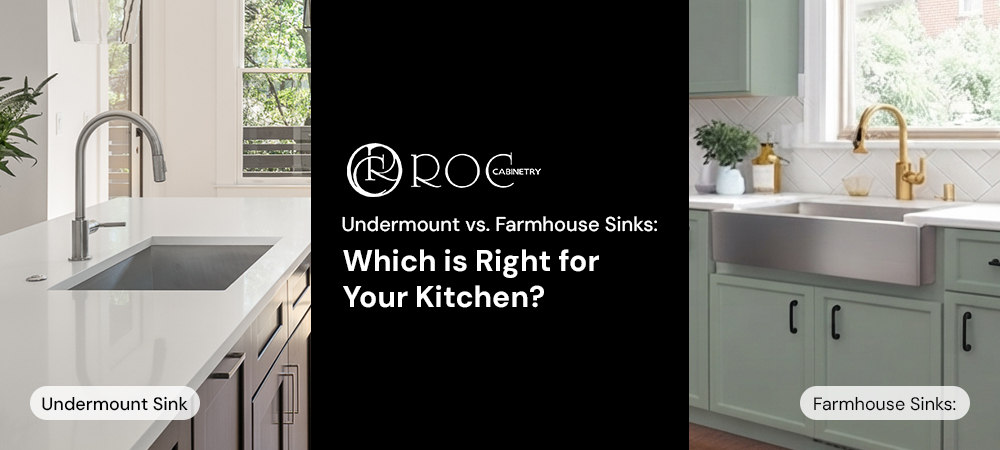
Undermount vs. Farmhouse Sinks: Which is Right for Your Kitchen?
Blog Summary
Choosing between an undermount sink and a farmhouse sink comes down to:
Design preferences
Functionality
Installation and cabinet requirements
ROC Cabinetry’s premium stainless-steel sinks deliver:
Durability
Easy maintenance
Timeless style
Undermount sinks offer:
A sleek, modern appearance
Effortless countertop cleanup
Compatibility with many standard sink base cabinets, depending on size and installation requirements
Farmhouse sinks:
Create a bold focal point
Provide a larger basin for busy kitchens
Require a compatible farm sink base cabinet and proper support
Stainless-steel farmhouse and undermount sinks offer lasting durability, easy maintenance, and timeless design appeal. For dealers, builders, and contractors, choosing the right sink style can help improve both kitchen functionality and the overall finished look.
Understanding Undermount Sinks
An undermount kitchen sink is installed beneath the countertop, creating a smooth transition between the counter surface and the sink basin. These sinks deliver a clean appearance without a rim sitting on top of the countertop. And according to Builder Magazine, 92% of kitchen designers favor them, making them a popular choice for modern and transitional kitchens because they create a clean look and make countertop cleanup easier.
Benefits of Undermount Sinks
Easy Cleanup
Homeowners can wipe crumbs, water, and food debris directly into the sink.
Clean, Contemporary Style
Undermount sinks create a streamlined look that allows countertops and cabinetry to take center stage.
More Usable Counter Space
Because the sink rim does not sit on top of the countertop, undermount sinks help create a cleaner surface around the sink area.
Pairs with Premium Surfaces
Undermount sinks pair well with quartz, granite, marble, and other solid-surface countertops.
Best Applications
Undermount sinks are a strong choice for modern, transitional, compact, and low-maintenance kitchens.
Farmhouse Sinks Explained
A farmhouse kitchen sink, also called an apron-front sink, features an exposed front panel that extends beyond the cabinet face. Grand View Research explains that farmhouse sinks remain highly popular in 2026. This is driven by an expected market compound annual growth rate of 5.5% through 2033.
Benefits of Farmhouse Sinks
Statement-Making Design
Farmhouse sinks often become a focal point within the kitchen, adding character, and architectural interest.
Larger Basin Capacity
Many farmhouse sinks feature deeper, wider basins that accommodate large pots, pans, baking sheets, and oversized cookware.
Better Ergonomics
Because the sink sits closer to the user, farmhouse sinks can reduce reaching during meal prep and cleanup.
Versatile Design Appeal
Stainless steel farmhouse sinks complement industrial, transitional, coastal, modern and contemporary kitchens.
Best Applications
Farmhouse sinks work well for busy family kitchens, larger layouts, entertainment focused spaced, serious home cooks, and homeowners looking for a strong design centerpiece.
Comparing Undermount and Farmhouse Sinks
Feature | Undermount Sink | Farmhouse Sink |
Appearance | Sleek and streamlined | Bold and Eye-catching |
Countertop Cleanup | Excellent | Good |
Basin Capacity | Moderate to large | Large to extra large |
Installation Complexity | Moderate | More involved |
Design Impact | Subtle and modern | Strong visual focal point |
Best For | Modern and transitional kitchens | Statement kitchens and heavy-use spaces |
Layout and Cabinet Considerations
Choosing between an undermount and a farmhouse sink can affect the cabinet
order, countertop fabrication, and installation timeline. Dealers, builders, and contractors should review the following requirements before finalizing the sink selection. H3 - Cabinet Modification and Support
Many undermount sinks can be installed with standard sink base cabinets, depending on the sink size and cabinet specifications. Farmhouse sinks typically require a compatible farm sink base cabinet and proper internal support to handle the weight of the sink and water-filled basin.
For ROC Cabinetry’s undermount and farm sink models, cabinet compatibility should be verified before ordering. Please refer to the chart below:
ROC Sink Size | Sink SKU | Compatible Cabinet SKU |
30” Wide Undermount Sink | SINK30UM-SB33 | SB33 |
32” Wide Undermount Sink | SINK32UM-SB36 | SB36 |
32-7/8” Wide Farm Sink | FARMSINK32UM-FSB36 | FSB36 |
35-7/8” Wide Farn Sink | FARMSINK35UM-FSB39 | FSB39 |
Countertop Fabrication
Undermount sinks require a precise, finished countertop cutout because the edge around the sink remains visible. They are commonly paired with solid-surface materials such as quartz, granite, or stone. Farmhouse sinks also require careful countertop fabrication, so the apron front aligns properly with the cabinet and countertop edge.
Cost and Installation Timeline
Dealers and contractors should note that farmhouse installations often involve higher labor and planning requirements because they may require apron-front cabinetry, added support, and more precise countertop fabrication. Farmhouse sinks can increase the overall installation cost and timeline.
Why Stainless Steel Remains a Popular Choice
Stainless steel continues to be one of the most popular sink materials in the industry because it offers durability, easy maintenance, and broad design compatibility. ROC Cabinetry’s stainless-steel sinks provide several advantages for today’s kitchen projects.
Exceptional Durability
Stainless steel is resistant to chipping, cracking, staining, corrosion, and heat damage, making it a durable option for busy kitchens.
Easy Maintenance
Unlike some sink materials that require specialized cleaners or ongoing sealing, stainless steel is simple to maintain and clean.
Timeless Design
Stainless steel complements a wide range of cabinet colors, countertop materials, and kitchen styles.
Long-Term Value
Because stainless steel offers durability and broad design compatibility, it provides long-term value for both homeowners and professionals to specify kitchen products.
The Bottom Line
Both undermount and farmhouse sinks offer unique advantages. Undermount sinks are ideal for homeowners who want a clean, low-maintenance look, while farmhouse sinks are better suited for projects that need a bold focal point and larger basin capacity.
ROC Cabinetry offers stainless steel sink solutions that complement today’s most popular cabinet styles and layouts. Before ordering a farmhouse sink, always confirm the sink size and recommend farm sink base cabinet to ensure proper compatibility.
CTA – Shop Kitchen Sinks
FAQs
1.Are farmhouse sinks harder to install than undermount?
Yes. Farmhouse sinks are usually more involved to install because they often require a compatible farm sink base cabinet, proper support, and careful countertop fabrication.
2.Which kitchen sink style is easier to clean?
Undermount sinks are easier to clean because homeowners can wipe debris directly from the countertop into the sink.
3.Are stainless steel farmhouse sinks durable?
Yes. High-quality stainless steel farmhouse sinks are designed to withstand everyday kitchen use and offer strong resistance to corrosion and wear.
4.Do farmhouse sinks work in modern kitchens?
Yes. Stainless steel farmhouse sinks work well in modern kitchens because they combine clean lines, strong functionality, and a bold apron-front design.
5.Which kitchen sink style adds more visual impact?
Farmhouse sinks typically create a stronger design statement because the apron front remains visible.
6.Do ROC farm sinks require a specific cabinet?
Yes. ROC farm sinks should be paired with compatible farm sink base cabinets. The 32-7/8" wide farm sink, SKU: FARMSINK32UM-FSB36, is recommended with the FSB36 Farm Sink Base Cabinet. The 35-7/8" wide farm sink, SKU: FARMSINK35UM-FSB39, is recommended with the FSB39 Farm Sink Base Cabinet. Always verify compatibility before placing an order.
7.Can undermount sinks fit standard sink base cabinets?
Many undermount sinks can work with standard sink base cabinets, but compatibility depends on the sink size, cabinet width, countertop material, and installation requirements.